Where We’re Supposed To Be
UJ PARTNERS WITH PHOENIX TO PROVIDE CRITICAL PATHOLOGISTS’ ASSISTANTS
Following one’s dreams and realizing potential career goals generally isn’t – and, arguably, shouldn’t be – all about the money.
But, dang, a quick refresher on the fruits of labor can be quite the pick-me-up.
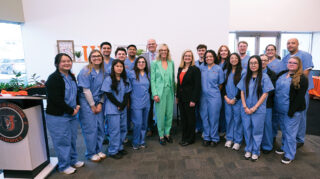
“You’re going to make more in your first year than the Mayor of Phoenix,” said Phoenix Mayor Kate Gallego to University of Jamestown’s first-ever Pathologists’ Assistant master’s program cohort.
Mayor Gallego earned a salary of $103,840 last year as the chief-elected official of America’s fifth-largest city. The average salary for a pathologists’ assistant (PA) is right around $115,000.
 “I’m so thrilled to welcome the University of Jamestown to The Cotton Center. We really want you to stay when you graduate.”
Gallego’s remarks came on Jan. 30 during UJ’s formal grand opening of its approximately 23,000-square-foot Health Sciences and Graduate Center, which is located just south of Phoenix Sky Harbor International Airport in the city’s bustling and biggest business park: the 280-acre Cotton Center.
UJ’s brand-new PA program welcomed its first class of 18 students to its sparkling Phoenix campus this semester. Coming from all areas to call Phoenix home for the next two years – and possibly beyond – UJ’s newest Jimmies began courses on Jan. 5.
Gallego has famously campaigned on transforming Phoenix into a national leader in biotechnology, and biomedical science graduate students, like 31-year-old Erin Pfeil from Cleveland, Ohio, have been waiting for an institution like UJ to saddle up and take the reins.
Unsuccessful attempts to enter PA programs at both Duke and West Virginia had Pfeil – a 2016 University of Cincinnati biology and anthropology graduate – working in operations for Nouhaus Inc., a Los Angeles-based furniture company.
The former microbiologist and grossing technician admitted that a career in office chair sales simply wasn’t her calling when, lo and behold, UJ finally appeared on the horizon with arms wide open.
“I’ve been interested in pathology since 2015. That was the first time I volunteered in the lab at University of Cincinnati Medical Center,” said Pfeil. “It seems like a gift to be here. There’s definitely been times during lectures where I’ve gasped, or made a sound, and then had to say, like, ‘I’m sorry.’
“Every class is so fascinating. I just get caught up in the lectures!”
Erin’s story has been playing out all over the country, as specific workforces in healthcare and biotech have struggled to keep pace in a world that’s being thrust forward by increasingly advancing technology and demand.
To help bridge the industry gap, UJ has entered a postgraduate world that includes only 15 other PA programs in the United States. Prior to UJ, programs in California and Texas were the only two located west of the Mississippi River.
When UJ Executive Vice President Dr. Paul Olson met with now UJ partner, Clin-Path – the exclusive pathology services provider to 10 hospitals in the Phoenix metro – he was told the average time it took to hire a PA in and around Phoenix was 11 months to a full year.
“From where I sit, that’s unacceptable,” Dr. Olson said. “When you have people who are waiting on cancer diagnoses and other diagnoses, we can’t afford to be waiting to make those kinds of hires.”
Those conversations took place more than two years ago, and since that time UJ persuaded Dr. Cheryl Germain, a nationally recognized leader in pathology education, to create and direct her third PA program. UJ also secured the services of Phoenix pathologist Dr. Raheel Ahmed to become the program’s medical director and was successfully able to merge its new Health Sciences and Graduate Center with its entire UJ Phoenix campus under one roof at The Cotton Center.
Call it divine intervention, but it was this serendipitous search to move UJ’s Phoenix campus to a more accommodating space than its former location in Park Central that ultimately led to the new PA program. A conversation between Dr. Olson and UJ’s Phoenix realtor, Mike Miller of Stream Realty Partners, produced a meeting between UJ and Clin-Path, another Stream Realty client.
The rest, as they say, is history.
“We came to Phoenix wanting to listen so that we can understand the issues and walk alongside the established institutions to help this city solve the real problems that it faces,” Dr. Olson said, “and I’m really proud to be a part of a university that listens to the people in the communities that we’re a part of.”
UJ’s 84-credit PA curriculum, developed by Dr. Germain and her team, blends didactic education, hands-on laboratory training, and immersive clinical rotations, while diving headfirst into the world of surgical and autopsy pathology.
UJ PA graduates will be highly trained experts in the examination and dissection of tissues received from operating rooms (ORs) and clinics. Those tissues, from biopsies to major cancer resections, are then submitted by PAs for microscopic diagnosis and molecular interpretation performed by pathologists, which ultimately results in the appropriate treatment and prognosis for patients.
“We are the eyes and hands of the pathologist,” Dr. Germain said. “Usually, when we’re working the patient is on the table in the OR, so we’re doing frozen sections with a STAT procedure where they need a diagnosis very quickly. The surgeon will bring in the tissue, and we’ll analyze it right there. There’s no time to spare.
“It’s always challenging, but it’s so much fun. We are a bunch of nerds, it’s true.”
Whether biopsies or resections are under emergency conditions or simply routine, current
technological advances in surgery and radiology have also placed PAs and pathologists on the cutting edge of earlier, more accurate diagnoses.
UJ PA graduates will be at the forefront of these advancing diagnostics to help finely-tune more accurate treatments quicker.
“We’re moving towards a precision medicine, genetic and proteomic approach to diagnosis and treatment, and pathologists’ assistants are going to be a huge part of that because they have the microbiologic background and knowledge in order to help make those more specific diagnoses that will help tailor therapies that we haven’t been able to perform in the past,” said UJ Vice President for Academic Affairs and Dean of the Graduate Faculty Dr. Kristin Lefebvre.
For instance, instead of patients receiving standard treatment for cancer as a first option, biodiagnostics can prescribe more effective types of radiation, chemotherapy or treatment based on a person’s specific genetic profile, including blood types and biomarkers.
Being able to immediately jump to what works best can prove vital.
”In a lot of cases, you see children actually die of side effects from the treatments for different cancer diagnoses,” Dr. Lefebvre explained. “They can be cancer free when they die but die from the complications of all the treatments that they’ve gone through to try and kill the cancer.
“Our graduates will be the first line of defense and are going to have a lot of influence in what’s really an industrial revolution of medicine.”
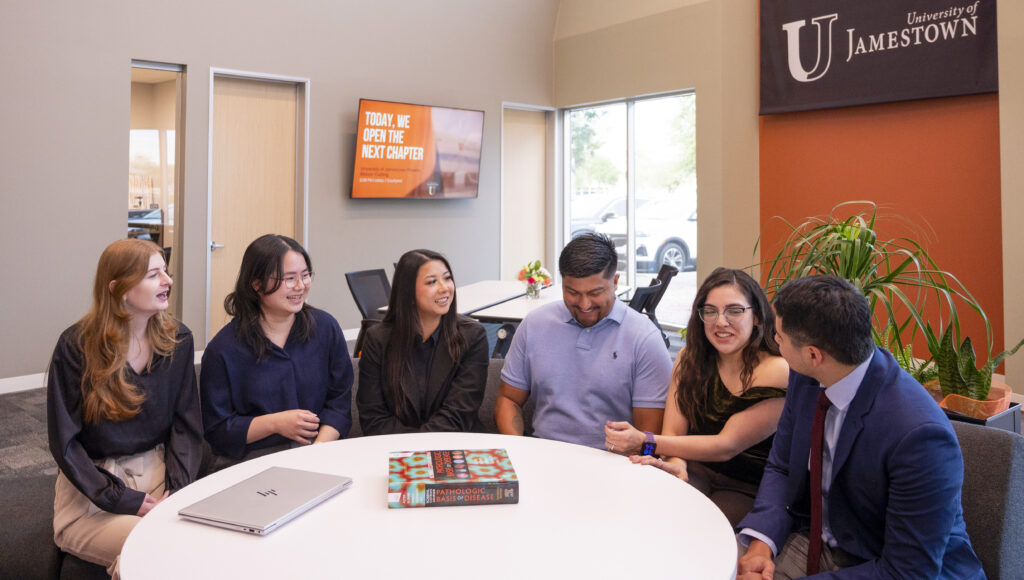 UJ’s 18 new Jimmies have quickly grown close while delving into Dr. Germain’s rigorous, med school-level curriculum.
“The bonding happened very quickly,” Pfeil pointed out. “We study together; we’ve gotten lunch together. It feels like we’re going to make life-long friends.”
The previous two programs developed by Dr. Germain were in medical schools – West Virginia University School of Medicine and Loma Linda University School of Medicine. The process of creating classes, hiring faculty, building clinical partnerships nationwide, and constructing a laboratory from the ground up in Phoenix for UJ was no small feat.
She credits UJ Clinical Coordinator Trevor Wolfe, who was a student of Dr. Germain’s at West Virginia and first connected her with Dr. Olson, and UJ Director of Business and Governmental Affairs Dr. Rob Stenson as being instrumental to the entire process.
Dr. Stenson’s level of providing detail and work outside the realm included UJ-branded coffee syrup in the faculty breakroom.
“None of this would have been possible without Rob,” Dr. Germain said. “It’s really been a good journey. We certainly have a lot of resources, my goodness, to have this beautiful building and a brand-new lab.”
It’s a Jimmie-worthy standard that UJ President Dr. Polly Peterson said wouldn’t be compromised.
“We believe that learning extends far beyond the classroom, and that education is not merely just about knowledge. It is about purpose,” President Peterson said. “As such, our university’s hallmark is a commitment to graduating professionals who can think critically, lead ethically and solve the complex problems that they will face.”
Jake San Souci, a 22-year-old PA student from Flagstaff, Ariz., is eager for the challenge. The Arizona State University graduate’s goal is to one day instruct the lessons he’ll learn at UJ.
“What I hope to get out of the University of Jamestown is to learn how to be a leader and a teacher,” said San Souci, who holds degrees in Pharmacology and Toxicology. “I hope that one day I can work at a university hospital and teach other PAs the profession.”
“I know these students will be so well trained that when they go out, they’ll be fantastic representatives of our university and our program,” Dr. Germain added. “They’ll be able to very quickly give us and our community a good reputation.”
 And UJ isn’t finished.
Two more programs are slated to launch this July at the Health Sciences and Graduate Center: a Master of Science in Computational Pathology and Digital Medicine – the first of its kind in the United States and only the second of its kinds in the world – and a Master of Science in Medical Sciences, geared for inspiring medical practitioners and researchers awaiting admittance into their discipline-specific degree.
“The University of Jamestown is honored to join so many talented professionals, innovative partners and visionary leaders in bringing biotechnology-focused educational solutions to support the priorities and initiatives of this great city of Phoenix,” President Peterson said.
In the meantime, Mayor Gallego is counting on UJ’s future PA graduates to help cut down the turnaround time of biopsies and laboratory results by reinforcing a Phoenix metro in major need.
This is a topic that hits home for the 44-year-old mother.
“At the time I was running (for mayor), my mom had been diagnosed with cancer and that was a really influential process on me,” Gallego said. “When you take a cancer test and then it’s a whole week before you get a result, there’s just always part of your mind that’s worrying about your loved one or yourself.
“So, the fact that we’ll be able to get better results faster, that you’ll bring new tools to our community, what a difference that will make for the people of Phoenix.”
The elder statesman of UJ’s PA students, 36-year-old Nicholas Atkinson from San Diego, admits the desert sun is already growing on him.
“I’m actually liking Arizona a lot,” said Atkinson, a National University (Calif.) graduate who’s been in pathology for 15 years as a grossing assistant and lab assistant. “I always tend to feel like I end up where I’m supposed to be, so if it ends up being here that would be great.”
Atkinson then smiled: “Our cohort has this phrase, ‘We’re where we’re supposed to be.’
“I feel like we all think we’re in the right spot.”