Don’t Call Me Coach
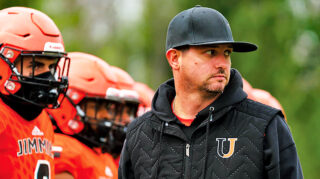
Brian Mistro ’09 Is Building Men, Not Just Teams—And Proving Leadership Is Learned.
Picture this: it’s a Jimmie Football Saturday. The crowd buzzes, the band plays, and one voice cuts clean through the noise. You hear him long before you find him—energetic, booming, unmistakable. He moves across the sidelines like a conductor, equal parts passion and positivity, carrying Jimmie pride in every step.
From the stands, Brian Mistro ‘09 is everything you hope for in a head football coach.
Sit down with him for a conversation, and it becomes clear: coaching is only a fraction of who he is.
“I don’t like the title ‘coach’ in the way society sometimes sees it,” Mistro says, “Don’t get me wrong, a coach is one of the coolest things you can be, but” he clarifies, “you’re so many more things than that. You’re a dad, a husband, a leader, a follower. There’s so much people don’t see.”
And it’s in that unseen space—beyond the scoreboard and lights—where his greatest impact lives.
 Ask any University of Jamestown football player Mistro’s first rule, and they answer without hesitation: “Be a good person.”
It’s simple. Repeatable. It is also the standard this larger-than-life coach who moved to Jamestown from Arizona to play Jimmie football, holds for himself.
In conversation with Mistro, story after story emerges—moments with players navigating loss, doubt, heartbreak, and growth.
These moments never appear on social media; the servant leader at heart wouldn’t dream of it. There are no cameras when he sits beside a quarterback after a crushing mistake, no posts when he shows up to a former player’s milestone, no announcements when he drives across town simply to be present.
The stories he tells are not about touchdowns. They are about young men becoming husbands, fathers, officers, neighbors—young men becoming whole.
Jimmie football under Mistro has a reputation of excellence. They show up. They volunteer. They’re respectful.
“I have this picture in my head that when you see a Jimmie football player, you know that’s the type of guy you’d be okay letting your daughter date,” Mistro says with a laugh. “A hard worker, a good person, someone genuinely bought into whatever he’s doing.”
That culture was built very intentionally.
“When I started, we didn’t just take anybody on the team. We wanted to take good people,” he says. “The football film tells you one thing, but the recruiting process tells you who good dudes are. Being a good person mattered more than being a good player when we started.”
As the program moves into Division II, Mistro says the culture of character has become self-sustaining: “When we bring in talented players now, they either join the culture—or they don’t last. We’re not adding cracks to the foundation here.”
It’s this commitment to culture and character that made Mistro a natural fit for the Doctor of Leadership program in UJ’s Unruh School of Character in Leadership (USCIL).
“I spent a long time talking to Brian before he started the program, why he wanted to do it, what he was hoping to gain,” says Dr. Liz Hunt, USCIL Director.
Hunt says Mistro had reservations, at that point feeling like he was “just” a football coach.
“At the end of the day, his passion for developing people, and his commitment to more than the game of football made him the ideal fit,” Hunt says.
The leader behind the whistle enrolled in the program in 2024 and has thrived ever since.
“What stands out most about Brian is his willingness to integrate his own leadership practice in real time,” says Dr. Ellen Beattie, one of Mistro’s instructors. “He doesn’t approach learning as something abstract or theoretical; he approaches it as a tool for becoming a better coach, mentor, and leader of young people.”
To outsiders, it can be surprising to learn that a head football coach is pursuing a doctorate. The assumption is that doctoral degrees belong to professors, researchers, and lecture halls. Mistro looks at it differently.
“I wanted to be better for my team,” he says. “They know I’m in the program, and they know I’m going through some of the same struggles they are with class. That bridges the gap. I’m not just telling them to get better—this is me trying to get better for them, too.”
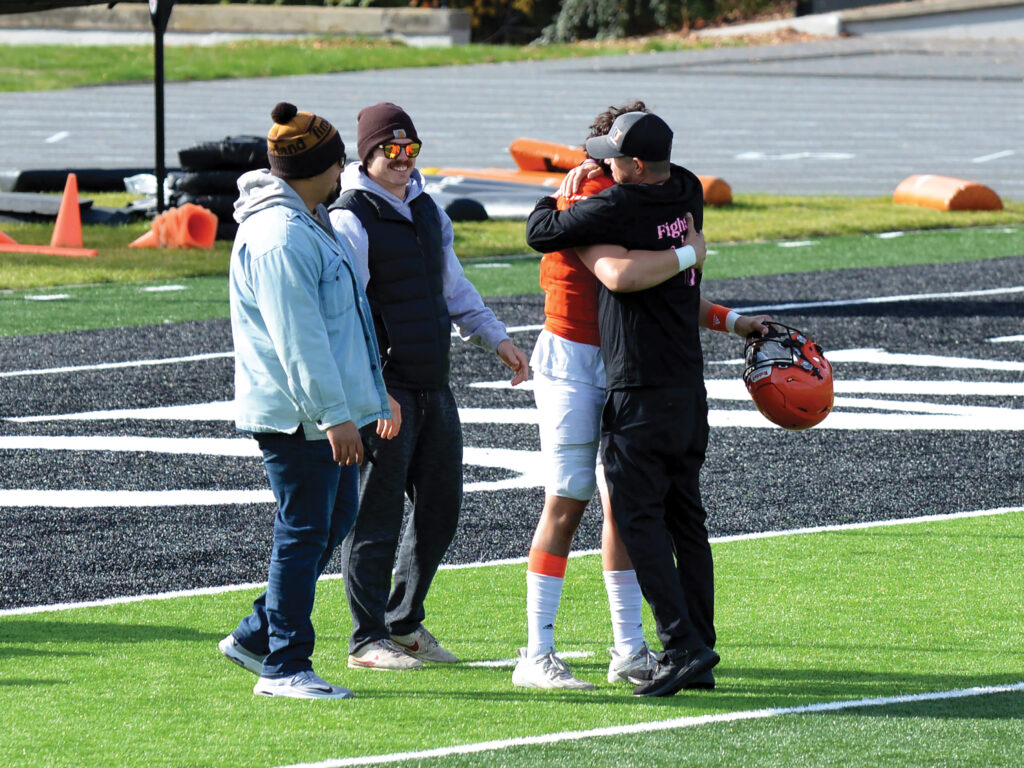
The impact on his leadership has been immediate.
“I didn’t realize how little I knew about the process of leadership,” the heart behind Jimmie football explains. “I’m so much more reflective now. I still make decisions, but now I take time to ask the players, ask the coaches, and reflect—did that work? That’s something I never used to do.”
Beattie says these immediate effects happen because the Doctor of Leadership program at UJ is practical versus solely academic.
“When learning immediately reshapes day-to-day decision-making, that’s when you know the program is doing what it set out to do,” Beattie says.
“Students like Brian don’t talk about hypothetical problems; they work on live ones,” she continues. “Brian is not completing assignments ‘about leadership’ in the abstract; he is actively using action research tools to navigate a real organizational transition, real athletes, real pressures, and real ethical considerations within his football program.”
The Unruh School of Character in Leadership was built for leaders like Mistro—leaders who understand that influence is not measured in wins, titles, or applause, but in the lives that grow because they were there. The building it’s housed in stands as a promise. Mistro is living proof of its fulfillment.
“His influence doesn’t stop with him,” Beattie explains. “The ripple effect is significant. That’s the multiplication—one leader creating conditions where many others can grow.”
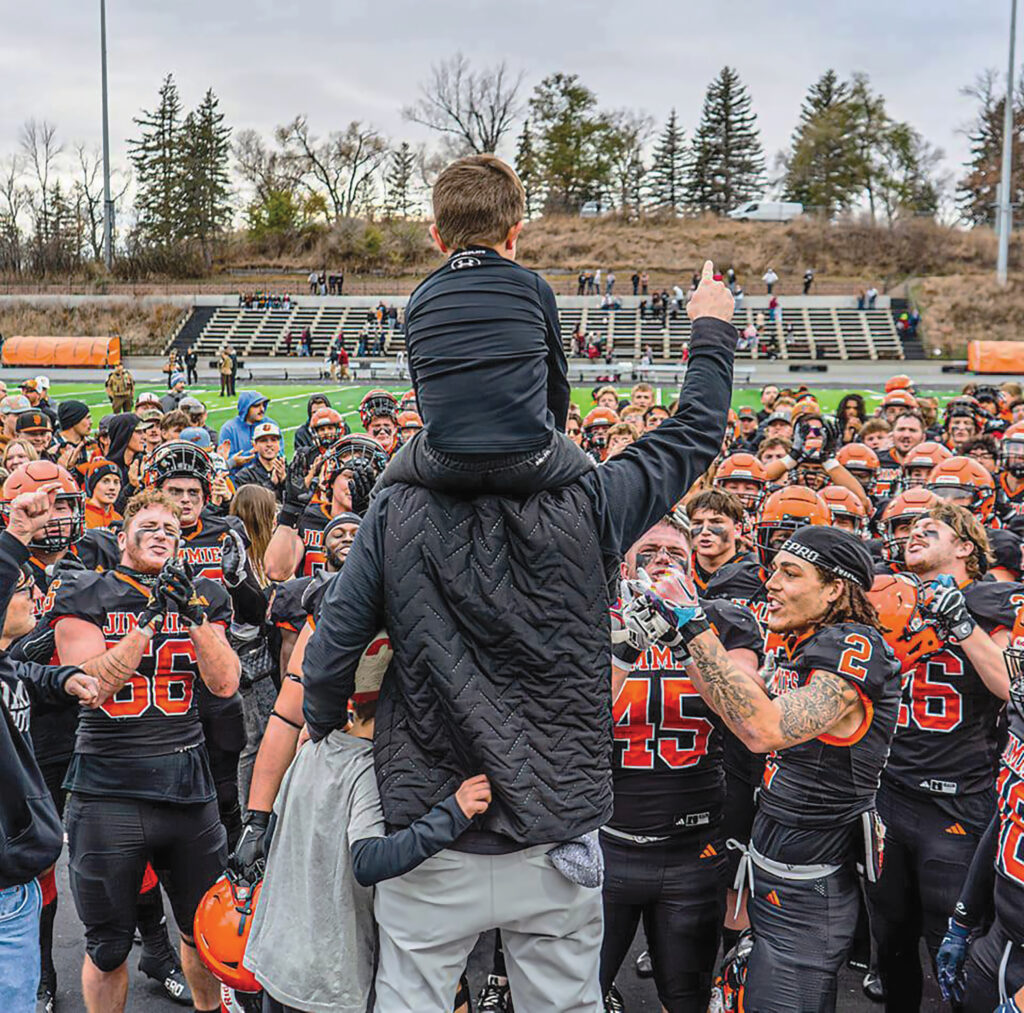 In athletics alone, Mistro’s influence reaches more than a hundred young men each year. Over time, those hundreds become thousands of families, workplaces, and communities shaped by lessons learned on the field and beyond. The multiplication of good is not abstract; it is steady. Cumulative. It is quiet and loud all at once—much like Mistro himself.
When asked what he ultimately hopes people know about him, his answer is disarmingly simple:
“If I can get to the point where people just know that I’m Brian—I also happen to be a coach and a dad and a husband—that’s really what matters.”
And in that simple sentence, you understand exactly who he is. The booming sideline presence. The reflective doctoral student. The mentor who shows up when no one is watching. The leader fulfilling the mission of a school that once existed only as an idea.
Jimmies are many things after all. And no one is prouder to be a Jimmie than Brian.
“If [coaching] were taken away from me tomorrow, there’s nothing more I’d want than to keep serving Jamestown somehow, in some way,” he says—talking softly for the first time. “I know that if I get this degree, I can still be used somewhere on this campus.
I would never be who I am today without this place.”