UJ Clinical Counseling Students Pursue Dual Licensure
Trailblazing a New Path: UJ Clinical Counseling Students Pursue Dual Licensure
For University of Jamestown graduate students Sara (Bonn) Dean, Brittney Risser and Ashley Woitel, pursuing two professional licenses means additional clinical hours, additional requirements and, as the first students to navigate the process, plenty of questions.
But the reason for doing it is much simpler.
Mental health and substance use do not always exist separately. Yet the professionals licensed to treat them often do.
“Most of my clients have co-occurring disorders where they have substance use and then also mental health needs,” Dean said. “If I can receive education that helps me help them better, then it’s kind of a no-brainer.”
Dean, Risser and Woitel are the first students in UJ’s Master of Science in Clinical Counseling (MCC) program to complete a dual internship, gaining clinical experience toward licensure in both professional counseling and addiction counseling in North Dakota. Along the way, they have worked with faculty to navigate licensing requirements and help establish a clearer path for future students.
They are not, however, the only members of their cohort positioned to pursue both licenses. Fellow MCC students Lacey Glueckert, Levi Greseth and David Sian entered the program already licensed as addiction counselors in North Dakota and recetly completed the mental health clinical counseling requirements.
Elsie Motter, MBA, MS, LMAC, LPCC-S, NCC, director of Clinical Counseling & Behavioral Health at UJ, has a name for them: trailblazers.
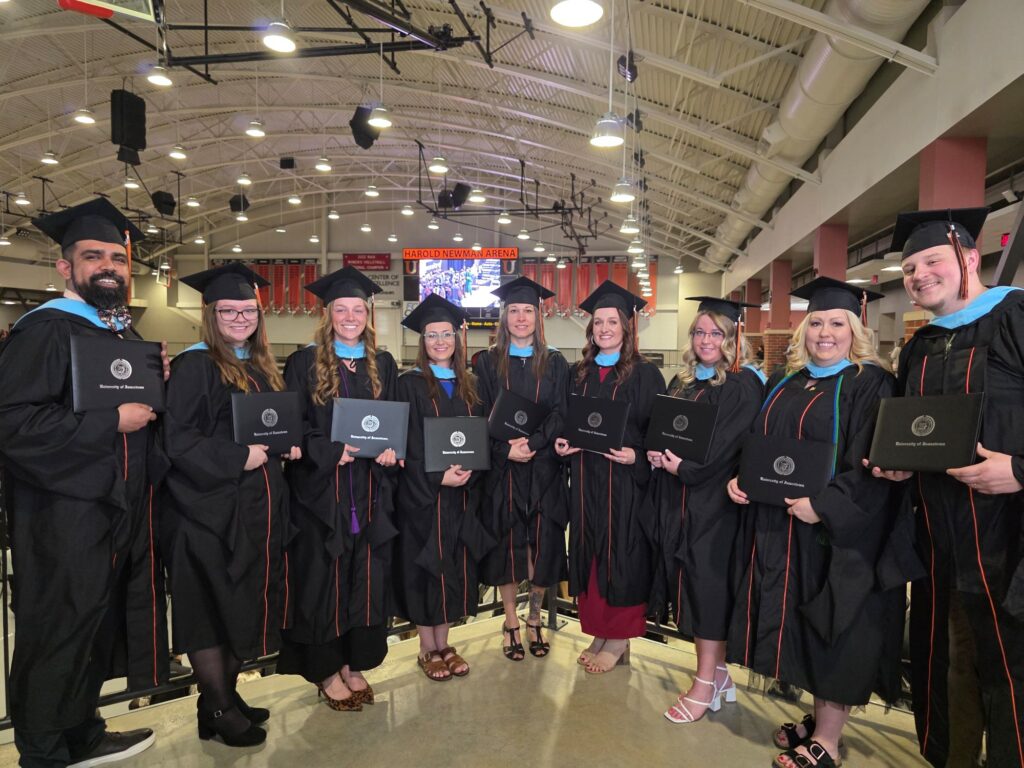
Missing from the picture was N’chelle Schmidt
Treating the Whole Person
For Motter, the value of dual licensure is something she understands personally. She spent seven years as an addiction counselor before returning to school for her master’s degree in professional counseling.
An addiction counselor’s scope of practice focuses on addiction, Motter explained. When clients also experience depression, anxiety, trauma or other mental health concerns, they may need to be referred to another provider. That can mean establishing another therapeutic relationship and sharing difficult experiences again.
“I was tired of having to refer people out and having them not follow through with the referrals because they just didn’t want to open up new wounds to new people,” Motter said.
Dual licensure can allow counselors to take a more holistic approach to client care and expand the services they are qualified to provide. It can also prepare graduates to better understand co-occurring mental health and substance use disorders. “I was really excited when we started the process of integrating more content into our courses,” Motter said. “Even if our students do not choose to pursue dual licensure, the understanding that they gain from increased educational content will continue to help reduce the stigma of addiction. For us, it ensures that all our graduates are recovery oriented for mental health and substance use.
The students are already seeing that need through their clinical experiences.
Woitel, who lives in Dickinson, North Dakota, did not enter the MCC program intending to pursue addiction counseling. Her perspective changed during her internship when she saw clients being referred to addiction therapists or placed on waiting lists.
At the same time, she began recognizing how frequently mental health and substance use concerns overlap.
“It’s the chicken or the egg,” Woitel said. “What came first? The substance use or the mental health? But they really are together.”
Risser reached a similar conclusion.
“If they have an addiction, they have to go to one counselor, and then if they have mental health issues, they have to go to somebody totally different and then re-explain everything again,” she said. “It’s not very beneficial to the client. It’s easier if they can just go to one person.”
Becoming the First
UJ’s 60-credit MCC program prepares students for professional counseling and includes both practicum and internship experiences. In recent years, faculty have also intentionally strengthened addiction-related content throughout the curriculum.
Students who choose to pursue the additional addiction counseling pathway complete additional addiction-specific clinical training and work toward requirements established by the North Dakota Board of Addiction Counseling Examiners (NDBACE).
For the first students through the process, that has required some problem-solving.
“We were blessed that they selected an internship site that had supervisors that could accommodate a dual licensure internship”, Motter said. “We submitted an individualized training plan to the NDBACE because they had already started their practicum. From there, their clinical supervisors worked with us to make this as successful as possible for our students. We knew that since it was the first time, it would likely have challenges.”
Questions emerged about how clinical hours should be categorized, what documentation was needed, and how supervision requirements worked across the two licensing areas.
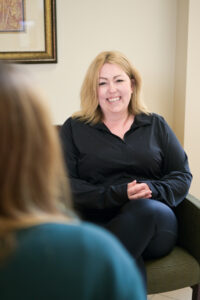
“At first, it was kind of rough because we were like, ‘How are we going to distinguish addiction hours from mental health hours?’” Risser said. “But now I feel like it’s actually not that difficult. Now we know how we’re supposed to do it.”
Two of UJ’s core MCC faculty members are dual licensed in North Dakota, giving the program experience with both licensing systems. Motter said lessons learned from this first group will help faculty continue refining the process for future students.
Dean admits that being among the first has occasionally been frustrating.
“It’s doable, and it’s enjoyable,” she said. “But it’s new, so there were some questions that didn’t have answers yet.”
Still, she has embraced being part of something new.
“Elsie keeps saying, ‘You’re not guinea pigs. You’re trailblazers,’ and it makes me giggle every single time,” Dean said. “It’s fun to be the first.”
She also sees value in knowing that their experience may make the process easier for others.
“Being able to be a part of a process that’s going to help other people in the future, where other students are going to have a little smoother ride—that’s nice to think about too.”
Different Paths, Shared Purpose
Although the three students are navigating the pathway together, each arrived there differently.
Dean earned her bachelor’s degree in psychology with a concentration in addiction counseling from UJ in May 2024 and began the MCC program that August. She knew by eighth grade that she wanted to pursue psychology, but her interest in addiction counseling grew through her work with clients.
“The more equipped I am to help, I’m going to jump at that,” Dean said.
One day, she hopes to open a private practice. For now, her focus is gaining the experience necessary to provide the level of care she wants to offer.
Woitel’s path began several hours away in Dickinson. After completing her undergraduate psychology degree at Dickinson State University, she searched for a graduate program that would allow her to continue working.
She found UJ’s online program.

“I was able to continue working and continue my education,” Woitel said.
In the program, she balanced full-time employment with an internship at a separate site in Dickinson. She calls the workload a “temporary sacrifice,” but one she believes is worthwhile.
Risser already had deep connections to UJ before entering the graduate program. She earned bachelor’s degrees in behavioral health and industrial business management from the University. Her father, now retired, also worked in counseling and previously taught at UJ.
“He had his own counseling practice and worked at the state hospital,” Risser said. “That’s kind of where I was like, ‘Hey, I’m going to do what you do.’”
Now Risser is preparing for another academic challenge. After completing her master’s degree and licensure process this summer, she has been accepted into a doctoral program in clinical research, where she is interested in eventually researching Alzheimer’s disease.
Creating a Path for Those Who Follow
UJ’s MCC program is primarily online, allowing students to remain in their communities while completing their coursework and clinical training. The program includes a three-day virtual residency during the first semester and a one-week, in-person residency in Jamestown during the first summer.
For Motter, flexibility and opportunities such as the dual-licensure pathway are connected to a larger challenge facing behavioral health: preparing qualified professionals to serve communities that need them.
Before entering higher education, Motter spent 20 years as a state employee and saw workforce challenges firsthand. Now, she sees an opportunity to approach those challenges from another direction.
“I love being on the other side of trying to solve that problem and look at how we can be really, really creative and push our boundaries and challenge the barriers,” Motter said. “We have to be part of the solution.”

For Bonn, that larger mission ultimately comes back to the individual sitting across from her.
Graduate school, clinical work and the requirements of pursuing two licensure pathways can be demanding. What keeps her moving forward are often the smallest moments like a client simply showing up, expressing gratitude or simply thanking her for listening.
“Those little moments of encouragement, they fill up the tank,” Dean said.
And when the workload becomes difficult, she returns to the reason she started.
“Just reminding yourself of the why,” Dean said. “Why you’re doing this, why you decided to start in the first place and where it could go.”
While Dean, Risser and Woitel were the first to complete a dual internship, they are not the only students to be graduating with the ability for dual licensure. Their cohort includes three students, Lacey Glueckert, Levi Greseth, and David Sian, who are already licensed in ND as Addiction Counselors.
“I am really excited for these students, but also the clients that they will serve,” said Motter.