Balancing Work, Family, and Innovation: How One PhD Student is Redesigning Clinical Trials
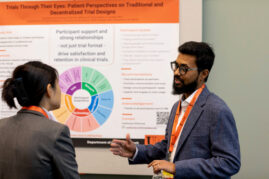
Sudharsan Krishnaraj, a PhD student at the University of Jamestown, is revolutionizing clinical trials by focusing on participant-centered research. Balancing a demanding career, a young family, and rigorous studies, Sudharsan is uncovering insights into decentralized clinical trials, aiming to make medical research more inclusive and accessible. His groundbreaking work, already gaining recognition, reflects the transformative power of education and innovation.
On a quiet Sunday evening, Sudharsan Krishnaraj sits down at his desk, ready to tackle another week’s worth of coursework. It’s a routine he’s followed for nearly two years, setting aside Sunday evenings to dive into lectures, assignments, and projects for his PhD program at the University of Jamestown.
For many, balancing a demanding full-time career, a young family, and graduate school might seem impossible. But for Sudharsan, 38, it represents the next step in a lifelong pursuit of education and purpose.
“I didn’t want to pursue a degree simply for the credential,” he said in a recent interview. “I wanted it to be meaningful and directly aligned with the work I’m doing.”
That work—collecting, curating, and analyzing clinical trial data—has defined his career for more than 18 years. But it’s his current research, focused on participant experiences in clinical trials, that could have a lasting impact on the way the medical research industry operates.
From India to Jamestown
Sudharsan’s journey began in Coimbatore, India, where he earned a bachelor’s degree in biotechnology and a master’s in bioinformatics. He started his career in clinical research in 2007 and, in 2011, moved to the United States to further his professional development. For years, he worked behind the scenes on clinical trials, building databases and managing the flow of patient data used to inform critical medical decisions.
But even as his career advanced, Sudharsan felt a persistent desire to deepen his impact.
“I had always wanted to pursue higher education,” he said. “It was a long-standing personal goal of mine. I wanted to experience being a student again here in the U.S.”
His search for the right program was meticulous. While he explored several graduate programs in biostatistics and related fields, he sought one that directly aligned with his extensive clinical research experience. After extensive research, he discovered the University of Jamestown’s PhD in Clinical Research program – an innovative online doctoral program designed for professionals advancing clinical research and healthcare.
“The program was a perfect fit for me,” he said. “It covers the entire length and breadth of the clinical research industry, and the flexibility allows me to balance everything else in my life.”
Sudharsan enrolled in 2024, committing to a rigorous schedule of remote coursework while juggling his full-time job and responsibilities as a husband and father to two young daughters.
A Family Effort

If graduate school is a marathon, Sudharsan’s wife, Saranya, has been his coach, cheerleader, and teammate every step of the way.
“She’s been my biggest support system,” he said. “Whenever I feel down, she reminds me why I started this journey and encourages me to keep going.”
With a one-year-old and a seven-year-old at home, life was far from quiet. But the family created a rhythm that worked: Saranya took charge of household responsibilities, giving Sudharsan the time he needed to focus on his studies.
“It’s been a roller coaster ride,” he said. “But we’ve made it work, and I’m grateful for her support.”
Rethinking Clinical Trials
Sudharsan’s research is driven by a question that’s followed him throughout his career: What is it like to be a participant in a clinical trial?
As a data management expert, Sudharsan has spent years building systems that collect information from trial participants. But he’s rarely interacted with those participants directly, leaving him curious about their experiences.
“I’ve always been behind the scenes,” he said. “I wanted to understand how the systems we create impact participants and how we can make clinical trials better for them.”
His curiosity led him to focus on decentralized clinical trials (DCTs), an emerging model that allows participants to complete trial-related activities remotely using digital tools. While DCTs surged in popularity during the COVID-19 pandemic, Sudharsan noticed a gap in the research: limited research had examined participant perspectives on this evolving model.
Listening and Learning
Working closely with his advisor, Dr. Kerstin “Kiki” Luther, PhD, Executive Director of the Dr. Jo-Ida C. Hansen Institute of Sponsored Programs, Innovation, and Research Excellence (InSPIRE) and Assistant Professor of Clinical Research, Sudharsan designed a qualitative study to explore participant experiences in both traditional and decentralized trials. He conducted focus groups with 19 participants, asking open-ended questions about their motivations, challenges, and overall satisfaction.
The findings revealed several important themes:
- Convenience vs. Connection:
Participants in decentralized trials appreciated the flexibility of participating from home but sometimes missed the personal interaction with trial staff.
- Technology Gaps:
While most participants adapted well to digital tools like apps and wearables, some struggled with technology or expressed concerns about data privacy.
- Barriers to Access:
Decentralized trials helped overcome logistical barriers—such as travel and time off work—that often prevent people from participating in traditional trials.
These insights, Sudharsan says, are just the beginning. He is now conducting a larger, quantitative study, surveying 200 participants to measure satisfaction levels in both trial models.
“The focus groups gave us a foundation,” he explained. “Now we’re diving deeper to understand what we can do to make trials more participant-friendly.”
A Vision for the Future
Sudharsan’s ultimate goal is to use his research to improve how clinical trials are designed. By centering participants in the process, he hopes to make trials more inclusive, accessible, and effective.
“One of the primary goals of my study is to create participant-centered trials,” he said. “We want to design trials that make sense for participants and are achievable for everyone involved.”
His work is already attracting attention. Sudharsan’s article, “Participant-Centered Insights on Clinical Trial Design: A Qualitative Study of Participant Engagement in Traditional and Decentralized Trial Designs,” was published in Journal for the Society of Clinical Data Management and his quantitative study is expected to provide even more actionable insights for trial sponsors, regulators, and designers.
For Sudharsan, UJ has been more than an academic institution – it’s been a partner in his growth.
“The program is incredibly well-designed,” he said. “It covers everything you need to know about clinical trials, from ethics committees to trial design. It’s directly applicable to my work, and the faculty have been so supportive throughout the process.”
He credits the program’s flexibility and comprehensive curriculum for helping him balance his many responsibilities while advancing his career.
“I’m so grateful I signed up for this program,” he said. “It’s helped me grow as a professional, a researcher, and a person.”
As Sudharsan continues his doctoral journey, his work represents more than academic achievement – it reflects a broader movement toward participant-centered clinical research. For faculty, he exemplifies the transformative power of education. For fellow students, he’s proof that balancing work, family, and school is possible with the right support system. And for alumni, his story is a reminder of the lasting impact of a University of Jamestown education.
Interested in learning more about the Clinical Research Administration program at the University of Jamestown?
Visit https://accelerated.uj.edu/academics/programs/clinical-research/ to explore how you can make an impact in the field of clinical research.