No Wasting Time
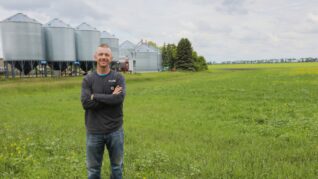
Brad Wolbert ’11 aims to fertilize fields by way of garbage trucks.
Brad Wolbert ’11 is that one guy some of us know and all of us wish we could be: fearless when faced with the challenge of trying new things.
And, no, we’re not talking about things like ice cream. We’re talking about things of real consequence, like raising a thousand meat rabbits almost overnight to provide waste fertilizer for his earlier devised organic regenerative farming operation.
The truly taking-the-bull-by-the-horns experiment, however, ultimately wasn’t his flavor, as Brad concluded that traditional composting methods better suited his present needs. But all the blood, sweat and tears he used on possible improvement – whether it worked or, as in this case, not – was simply another mile on the road the father of four is hardwired to walk.
You see, Brad can’t sit still. It’s physically painful for him, and in 2015 when he moved with his wife, Cara, from Fargo to her fourth-generation family farm nine miles north of Cathay, North Dakota, the sudden slower pace of life sent the wildly innovative mind of the former insurance broker into hyperdrive.
Thirteen-hour days bouncing around in a tractor produces numerous epiphanies for a guy like Brad. Some are worth pursuing, some can prove lousy, and then there’s everything in between.
“Every night my wife gets to hear these new stories I come up with,” laughed the 37-year-old former Jimmie homecoming king, whose Business Administration degree earned at UJ came with a concentration in Finance and Wealth Management. “My mind just wanders … and I’m learning vicariously through experience.”
For 12 seasons now, Brad has worked side-by-side with his father-in-law, Todd Bibelheimer, tending to his family’s farm that has acreage into the thousands. Three hundred of those acres is where Brad has carved out the beginnings of his organic growing journey, which he says he would attempt to grow substantially as soon as he can both devise a way to more effectively weed large swaths of land naturally and come up with the right product to produce and sell direct to consumers, instead of simply providing a raw commodity.
Time is on his side.
“I’m not anti-traditional farming with chemicals,” Wolbert said. “But if there’s a better way, and I think there’s a better way, then I’ve got to figure out how to do it.”
And ever since purchasing Double M Sanitation, a rural-area garbage collection service, with a partner five years ago, he’s been able to advance his passion to solve problems through the possibility of producing sustainable energy.
Brad’s latest big idea? He’s hoping to significantly reduce local landfill waste by turning his sanitation venture into an approximately 50,000 square-foot energy and recycling center to be located either near or on his family farm in Wells County. The energy produced would be in the form of electricity, which would then power a green nitrogen fertilizer plant.
“The idea is basically to build a facility that gets rid of the garbage and makes electricity, then have another facility that’s making nitrogen in the form of water,” Brad said. “So, farmers could then come and hook their sprayers or fertilizer tanks up to it and bring it home.”
A partnership with Frontline Waste, a U.S.-based company founded in 2018 that focuses on using thermal conversion technology to reduce waste by converting it to energy, is where the process would all start. A pyrolysis unit developed by Frontline would heat garbage to 1,200 degrees Fahrenheit, producing a combustible synthesis gas through thermochemical decomposition. The gas would then be transferred to a low-grade marine engine where it would fuel the generation of electricity.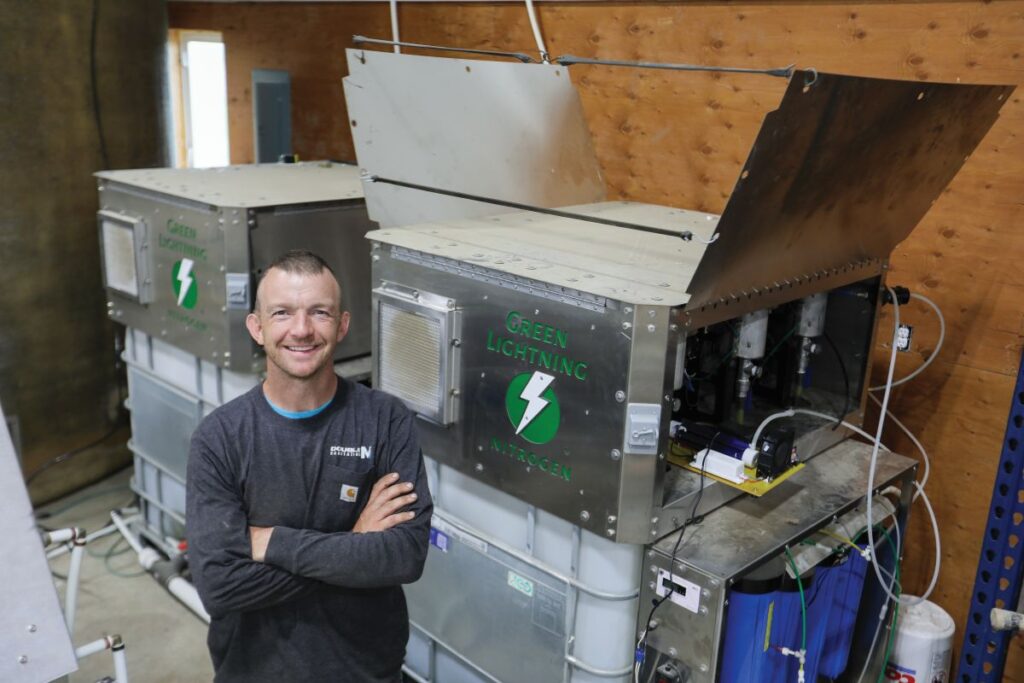
The electricity would go on to power nitrogen-producing machines developed by another U.S.-based company called Green Lightning. According to Green Lightning, their units send air and water into a controlled static electric field, and, by way of an electric shock, break apart atmospheric nitrogen gas which then bonds with oxygen to form nitrogen oxides. The nitrogen oxide dissolves into the water as natural fertilizing nitrates, or nitrogen. The process is modeled after the naturally occurring nitrogen produced by lightning strikes and occurs in the blink of an eye.
“The pyrolysis unit can consume 20 tons of garbage per day,” Brad said. “But it can only cook garbage, no metals or glass. We would need a facility out of the elements that’s big enough to store garbage as it’s being sorted for recyclables before being cooked.”
Brad already has a handful of Green Lightning units and is putting the nitrogen-producing machines through their paces. He explained Frontline would build him a custom pyrolysis system that would ultimately convert garbage into electricity, but the cost and scope of his ideal dream-big vision is immense.
“I estimate I’ll need $10 or $15 million. The (Frontline) unit is $2.5 million just by itself, but they want me to jump in right away and told me, ‘Hey, we’ll rent the unit to you,'” Brad said. “On one hand that’s great, but on the other hand I’d like to buy another quarter of land to have enough space to build this facility and have room to expand.”
Brad is hoping to secure backing through either private investors or the state. North Dakota has historically been a good friend to energy producers, chiefly in oil, coal, and natural gas, but renewable energy is becoming increasingly visible, and Brad is hoping to become a new player.
Double M Sanitation currently serves between 7,500 to 10,000 central North Dakota residents in Sheyenne, Minnewaukan, Maddock, Fessenden, Sykeston, Bowden, Hurdsfield, Goodrich, Turtle Lake, Selz and Barlow, and hauls between 80 to 100 tons of garbage to a landfill in Sawyer every week. The operation could also expand if hauling garbage to a destination north of Cathay is more cost effective for other nearby municipalities than a landfill farther away.
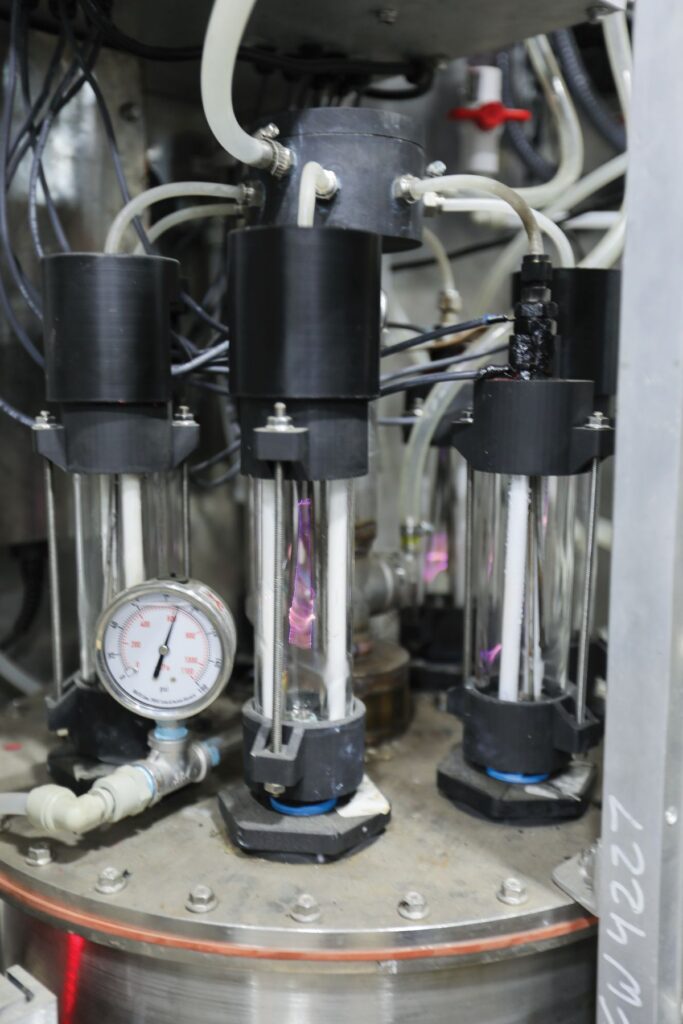
Converting 20 tons of garbage per day into energy would mean it’s possible Brad’s operation could continue 24 hours a day, seven days a week.
Brad estimates the energy made could power 770 Green Lightning units that could produce a total of 77,000 gallons of nitrogen daily. He said farmers could consume roughly 100 gallons of nitrogen per acre, meaning 7,700 acres of farmland could be fertilized every 24 hours.
And here’s the real kicker, Brad has calculated that the entire process would cost less than 10 cents a gallon, or about $8 to $10 per 100 gallons produced. Currently, he says farmers spend about 10 times that amount to fertilize their fields, at around $100 to $150 per acre.
“If I could sell this at 15 or 25 cents a gallon, and if farmers can get a better product for a lesser price, and you could keep it local, everyone wins.”
The manpower Brad will need to achieve his dream is already being fortified through his entrepreneurial drive. To keep Double M Sanitation trucks on the road, he’s hired additional staff to supplement truck operators who not only buy and flip trucks to sell, but they also serve has handymen to his various operations.
He currently employes approximately 10 people, and his handymen were hard at work in 2024 renovating a 28-unit apartment complex in Harvey that Brad and family members purchased. BOLD Enterprise is the name Brad has given his garbage truck and handyman operation, which will also act as the stabilizing force powering his future endeavors.
“Nobody ever thinks of bold as being bad,” Brad smiled. “And if I could get rid of garbage to make energy to make fertilizer, I think that’s my perfect scenario.
“God has given me this drive, so why not use it?”
It was a drive nurtured at UJ, a place his grandparents – Kent Cummings ’50 and Floyce Cummings ’51 – received their undergraduate diplomas. It’s also a place that prides itself in educating lifelong learners, like Brad, who aren’t afraid to dirty a shirt in pursuit of success.
“UJ helped pique my curiosity in many different things and taught me how to work with people on the college field or in the classroom,” said Brad, who played men’s soccer for the Jimmies and was also Student Body President. “After all the things that I’ve done, it’s one of those things where I’d still go back and do it all over again.”
That’s saying something for someone who’s always looking ahead, and who just might be on the cusp of impacting generations of North Dakotans.
“I’m going to put my best foot forward and I’m going to make it happen,” Brad said. “Lord willing, if it works, it works.”
It’s easy to forget that some ancient innovator once tossed an anchovy on flatbread and proclaimed “voilà” to the delight of millions of present-day pizza lovers.
Brad’s that guy.