
- Assistant Professor
Mechanical Engineering
- Major
Today’s engineers need to think about sociological, cultural, and environmental impacts of designs. That’s why our program combines the rigorous foundation of engineering courses with the human dimensions of technology through a curriculum grounded in the liberal arts.
- ABET Accredited
- Small class sizes
- Close-tied industrial partnerships
- Industrial partnerships for work experience
- Newly equipped educational laboratories
- Combined hands-on experience and fundamental education
- Targeted and well-equipped educational laboratory experiments
Gain real life experience, all before you graduate.
Our curriculum, course content, laboratory experience, design projects, teaching, and extracurricular activities are all oriented to simulate real-world experience, including:
- Labs
- Physics
- Material Testing
- Fluid Mechanics
- Instrumentational Electronics
- Engineering Computer Lab, which houses 25 new computers with 3D Drafting, Finite Element Analysis modeling software, and software for computer programming, as well as a virtual reality characterization station
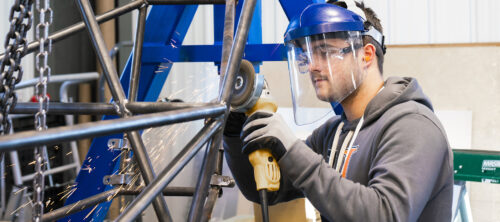
- Senior Design Lab, which contains manufacturing, welding, and 3D printing equipment
- Internships and Cooperative Education
Course Requirements
All required courses are listed in the academic catalog. To view specific course requirements:
- Visit the academic catalog here
- Select your program of study from the list
- Click “Requirements”
Additional Academic and Program Information
ACCREDITATION
The Bachelor of Science program in Mechanical Engineering is accredited by the Engineering Accreditation Commission of ABET, under the commission’s General Criteria and the Program Criteria for Mechanical and Similarly Named Engineering Programs.
Program Objectives and Student Learning Outcomes
Mechanical Engineering Student Learning Outcomes
Students who succesfully complete the Mechanical Engineering program at the University of Jamestown will have the ability to:
- Identify, formulate, and solve complex engineering problems by applying principles of engineering, science, and mathematics
- Apply engineering design to produce solutions that meet specified needs with consideration of public health, safety, and welfare, as well as global, cultural, social, environmental, and economic factors.
- Communicate effectively with a range of audiences.
- Recognize ethical and professional responsibilities in engineering situations and make informed judgements, which must consider the impact of engineering solutions in global, economic, environmental, and societal contexts.
- Function effectively on a team whose members together provide leadership, create a collaborative environment, establish goals, plan tasks, and meet objectives.
- Develop and conduce appropriate experimentation, analyze and interpret data, and use engineering judgment to draw conclusions.
- Acquire and apply new knowledge as needed, using appropriate learning strategies.
Life After Graduation
The Program Educational Objectives (PEOs) for Mechanical Engineering are that within a few years of graduation Mechanical Engineering alumni should be able to:
- Obtain professional licensure
- Integrate technological advances, ethical concerns, and current evidence into engineering practice
- Participate effectively as a member or leader on any interdisciplinary team
- Develop a habit of life-long learning to the benefit of their workplace and community
- Instructor

- Associate Professor
- Machinist
- Assistant Professor
- Associate Professor
- Engineering Division Director
- Mechanical Engineering Chair

- Associate Professor
- Civil Engineering Department Chair
- Professor

- Associate Professor
Tuition and Financial Aid
We believe every student, regardless of their financial situation, should have access to a UJ education. All on-campus students enrolled in the undergraduate college have some type of financial aid, with scholarship packages starting at $8,000 minimum.