UJ Physical Therapy Professor Featured in New York Times for Revolutionary Egyptian Mummy Research
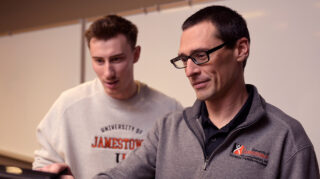
Dr. James Schanandore's 3D printing expertise bridges ancient medicine and modern healthcare innovation
Dr. James Schanandore, Professor in the University of Jamestown’s Physical Therapy program, has earned national recognition in The New York Times for his role in groundbreaking research using 3D printing technology to unlock medical secrets from ancient Egypt. Read the full article here.
From Ancient Egypt to Modern Innovation
Schanandore joined a prestigious research team that combined high-resolution CT scanning with medical-grade 3D printing to conduct virtual autopsies on two Egyptian mummies. The team created life-size reproductions of burial amulets and pathology found in the spine and hips —allowing researchers to study ancient anatomical structures without damaging the individual and the priceless artifacts. His expertise proved invaluable in analyzing the mummies’ various anatomical structures and providing historical context for the findings. The University of Jamestown will be permanently recognized in the accompanying museum exhibit, listed alongside Schanandore’s name as a contributing expert institution—a prestigious acknowledgment of UJ’s growing reputation in innovative research.
The Technology Breakthrough
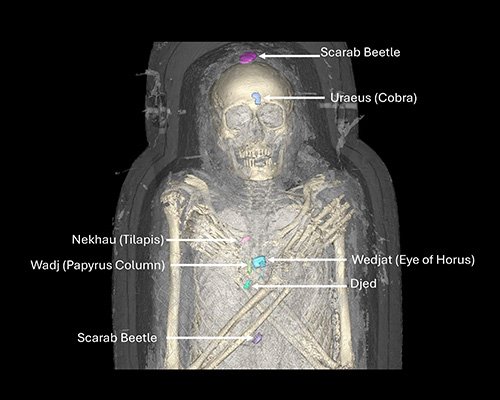
What made this research possible wasn’t just 3D printing, it was a dramatic leap in imaging technology. The mummies were originally scanned in 1995 using a low resolution scanner. The new scan was completed using a high resolution 320-slice scanner. The new scan was able to detail anatomical features more accurately, which made interpretation of any anatomy easier. “It’s like building with Lego blocks,” Schanandore explains. “The old scans were like using big Lego blocks, you could build something, but it would look boxy and interpretation of 3D models was challenging. With the new high-resolution scans, it’s like using tiny Lego pieces to 3D model the same anatomy and determining the presence of pathological conditions becomes much easier. In addition, the 3D printer can create bones that look exactly like the real thing.” “The printer prints what you give it,” Schanandore notes. “If the scan quality is low, the print will be boxy. But with these high-resolution images, we can produce anatomically precise bone reproductions. ” This technological advancement allowed the team to discover and interpret anatomical features that were either invisible in the original scans or impossible to make sense of with lower resolution data. For example, one of the mummies may have evidence of neurosurgery in the spine, and if confirm, it would the first documented case in an Egyptian mummy .”
The result: a window into ancient medical practices that researchers could only dream about three decades ago.
Beyond the Headlines: Local Impact
This national recognition represents just one chapter in Schanandore’s pioneering work with 3D printing technology. His innovations directly impact both education and patient care:
Custom Prosthetics for Kids
Schanandore designed and printed a custom prosthetic hand for a 9-year-old girl with a congenital hand deficiency who participates in activities at TNT Kids Fitness. The project, published in the Pediatric Physical Therapy Journal, demonstrated measurable improvements in functional participation—enabling her to engage in gymnastics alongside peers.
Revolutionizing PT Education
He created 3D-printed vestibular (inner ear) system models for neuroscience and vestibular rehabilitation courses, giving students tactile, hands-on learning tools that bring complex anatomy to life. These models transform how future physical therapists understand spatial relationships and functional anatomy.
Clinical Innovation
Currently, Schanandore collaborates with Assistant Professor Chelsey Asiala on developing 3D-printed ankle foot orthoses (AFOs) being clinically tested at PAM Rehabilitation Hospital in Fargo—translating cutting-edge technology into direct patient benefits.
Why This Matters
“Dr. Schanandore is an exceptional educator and an innovative researcher who excels on multiple levels. In the classroom, he demonstrates remarkable skills in assessment design, curriculum development, and policy implementation. Students consistently praise his teaching. He balances high expectations with genuine compassion and demonstrates unwavering commitment to their success. Beyond the classroom, he’s deeply engaged in both program-level and university-level initiatives, contributing meaningfully to our institutional advancement. Simply put, Dr. Schanandore represents the very best of what it means to be both an educator and scholar,” said Program Director and Professor of the University of Jamestown Doctor of Physical Therapy Program, Dr. Tara Haj, PT, DPT, EdD.