
- Assistant Professor

Civil Engineering
- Major
Program Details
Our Bachelor of Science in Civil Engineering program was designed for students interested in becoming well-rounded engineers. Our department focuses on interdisciplinary education. That means you won’t just learn civil engineering. Instead, you’ll get a much broader perspective.
Our courses help you understand how the decisions you make as a civil engineer can impact the communities you work in. You will be equipped with foundational knowledge in the six subdisciplines of civil engineering: water resources engineering, structural engineering, environmental engineering, transportation engineering, geotechnical engineering, and construction engineering.
You will learn drafting, coding, and other software skills that are highly desired in the workplace. You will work on several class design projects and a senior capstone design project that will expose you to engineering design. Finally, you’ll learn about sustainable engineering that will equip you to be mindful of the environmental impact of engineering projects. All the above is to ensure that you’re prepared to identify, formulate, and solve complex problems through engineering design that make communities run more efficiently without adverse impact.
What’s it like to be a Jimmie in the Engineering Department?
Communication is big in our department. It’s one thing to be able to solve problems. Communicating your ideas and effectively conveying their impact—that’s an entirely different skill. One that’s extremely important when you’re a civil engineer.
Gain real-life experience.
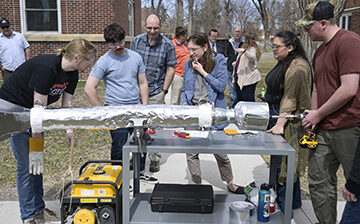
Put your engineering knowledge into practice through hands-on learning and opportunities to explore the profession. From working with state-of-the-art equipment in the lab to gaining professional experience through internships, you’ll build the skills, knowledge, and confidence needed to succeed as a civil engineer.
Lab Work
Labs for the civil engineering program are housed in a renovated facility with current, state-of-the-art equipment. That means when you graduate, you’ll have experience working with the same equipment you trained on in school.
Internships
Gain valuable work experience and make informed career choices through internships of a semester or more in length. Our Career Center can help you find and secure an internship.
Course Requirements
All required courses are listed in the academic catalog. To view specific course requirements:
- Visit the academic catalog here
- Select your program of study from the list
- Click “Requirements”
Why UJ?
- Small class sizes give you the opportunity to connect with your professors and peers
- Involvement is encouraged. We work closely with students involved in athletics, the arts, and other campus organizations, so they can participate in the activities they love and still earn their engineering degree.
Dedicated to Diversity
One third of our engineering faculty are women. Plus, our students come from all over the country and the globe, bringing with them diverse cultures and experiences that are celebrated on campus.
Program Objectives and Student Learning Outcomes
Civil Engineering Student Learning Outcomes
Students who succesfully complete the Civil Engineering program at the University of Jamestown will have the ability to:
- Identify, formulate, and solve complex engineering problems by applying principles of engineering, science, and mathematics
- Apply engineering design to produce solutions that meet specified needs with consideration of public health, safety, and welfare, as well as global, cultural, social, environmental, and economic factors.
- Communicate effectively with a range of audiences.
- Recognize ethical and professional responsibilities in engineering situations and make informed judgements, which must consider the impact of engineering solutions in global, economic, environmental, and societal contexts.
- Function effectively on a team whose members together provide leadership, create a collaborative environment, establish goals, plan tasks, and meet objectives.
- Develop and conduct appropriate experimentation, analyze and interpret data, and use engineering judgment to draw conclusions.
- Acquire and apply new knowledge as needed, using appropriate learning strategies.
Life After Graduation
The Program Educational Objectives (PEOs) for Civil Engineering are that within a few years of graduation Civil Engineering alumni should be able to:
- Obtain professional licensure
- Integrate technological advances, ethical concerns, and current evidence into engineering practice
- Participate effectively as a member or leader on any interdisciplinary team
- Develop a habit of life-long learning to the benefit of their workplace and community
- Instructor

- Associate Professor
- Machinist
- Assistant Professor
- Associate Professor
- Engineering Division Director
- Mechanical Engineering Chair

- Associate Professor
- Civil Engineering Department Chair
- Professor

- Associate Professor
Tuition & Aid
We believe every student, regardless of their financial situation, should have access to a UJ education. All on-campus students enrolled in the undergraduate college have some type of financial aid, with scholarship packages starting at $8,000 minimum.